
It’s not the centerpiece—but never irrelevant.
Positioning within private and institutional collections for the 50 dollar note reflects a high degree of selectivity.
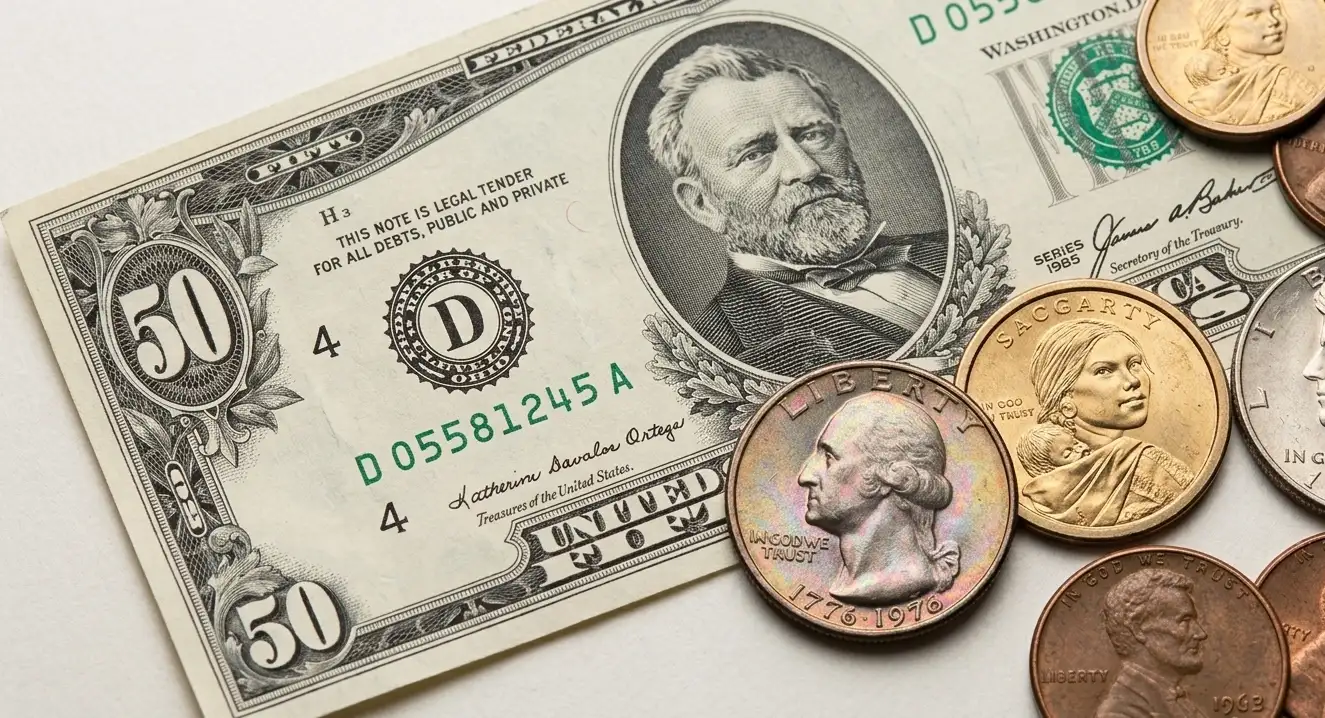
Parameter | 2004–2026 Issue Value |
Web Width | 155.956 mm |
Web Height | 66.294 mm |
Total Mass | 1.00 grams |
Sheet Thickness | 0.11 mm |
Cotton Content | 75% |
Linen Content | 25% |
Lacking wood pulp in the blend prevents natural paper yellowing during proper storage.
Security thread integration occurs during the initial paper mass formation.
Blue and red fibers are distributed randomly across the entire surface of the blank.
Classifying Series by Production Periods
History of the $50 bill is divided into several technological stages.
Each period features a shift in printing standards.
Period | Design Type | Key Feature |
1928–1990 | Small Portrait | No security threads or watermarks |
1990–1996 | Transitional | First security thread and microprinting added |
1997–2004 | Large Portrait | Off-center portrait and watermark introduction |
2004–2026 | NexGen | Colored background and modern holograms |
Rarities from the 1928–1934 period possess maximum growth potential.
Reducing quantities of surviving notes from these series → Higher entry barriers for collectors.
Perfect specimens of the 2004 issue are beginning to form a premium market segment.
Serial Number Value Analysis
Digital codes on a banknote serve as a defining factor for specific collector categories.
Standard serial numbers consist of 11 characters.
Types of In-Demand Combinations:
Low Numbers: Below 00000500
Solids: All digits are identical (e.g., 77777777)
Radars: Reading identically in both directions
Ladders: Consecutive digit sets like 12345678
Radar notes in 65 Gem Uncirculated condition trade for $250 in 2026.
Premiums for serial 00000002 can reach 3000% over face value.
Finding a rare combination via the best coin appraisal app in a bank pack carries a probability of 0.003%.
Automated sorting systems in banks reduce the chances of these notes entering open circulation.
Manufacturing Technology and Quality Control
US Bureau of Engraving and Printing applies a multi-stage product verification process.
Printing occurs at two facilities in Washington and Fort Worth.
Production Cycle:
Preparing paper webs with embedded security features.
Offset printing of background colors and patterns.
Intaglio printing of main portraits and inscriptions under high pressure.
Numbering and applying Federal Reserve seals.
Cutting sheets and forming 100-unit packs.
Cutting stage errors create expensive collectible mistakes.
Image shifts exceeding 3 mm → Note value rises to $400.
Inverted watermarks are considered unique defects.
Role of the Capitol in Reverse Design
Note reverses contain an image of the US Capitol's West Front.
Drawing maintains continuity since the mid-20th century.
Engraving Details:
Central Dome: Displayed with high architectural line precision.
"In God We Trust" Inscription: Positioned above the dome.
Guard Frames: Protecting note edges from wear and forgery.
Denomination Digits: Rendered in large font for easy identification.
Utilizing yellowish and blue background tints complicates scanning.
Design updates aiming for stronger protection are planned beyond 2026.
Existing reverse styles will become part of the US historical heritage.
Preservation Methods and Asset Conservation
Physical destruction of cotton fibers leads to grade loss.
Collectors apply strict environmental standards for long-term storage.
Material Degradation Causes:
Ultraviolet Radiation → Breaking cellulose bonds.
Humidity above 55% → Mold formation.
Temperature Fluctuations → Condensation risk inside packaging.
Skin Contact → Oil oxidation and dark spot appearance.
Using the best coin identifier app for regular checks and holders made of clear plastic prevents chemical reactions.
Storing in bank vaults ensures a stable microclimate.
Condition assessment via the PCGS Banknote system guarantees asset liquidity.
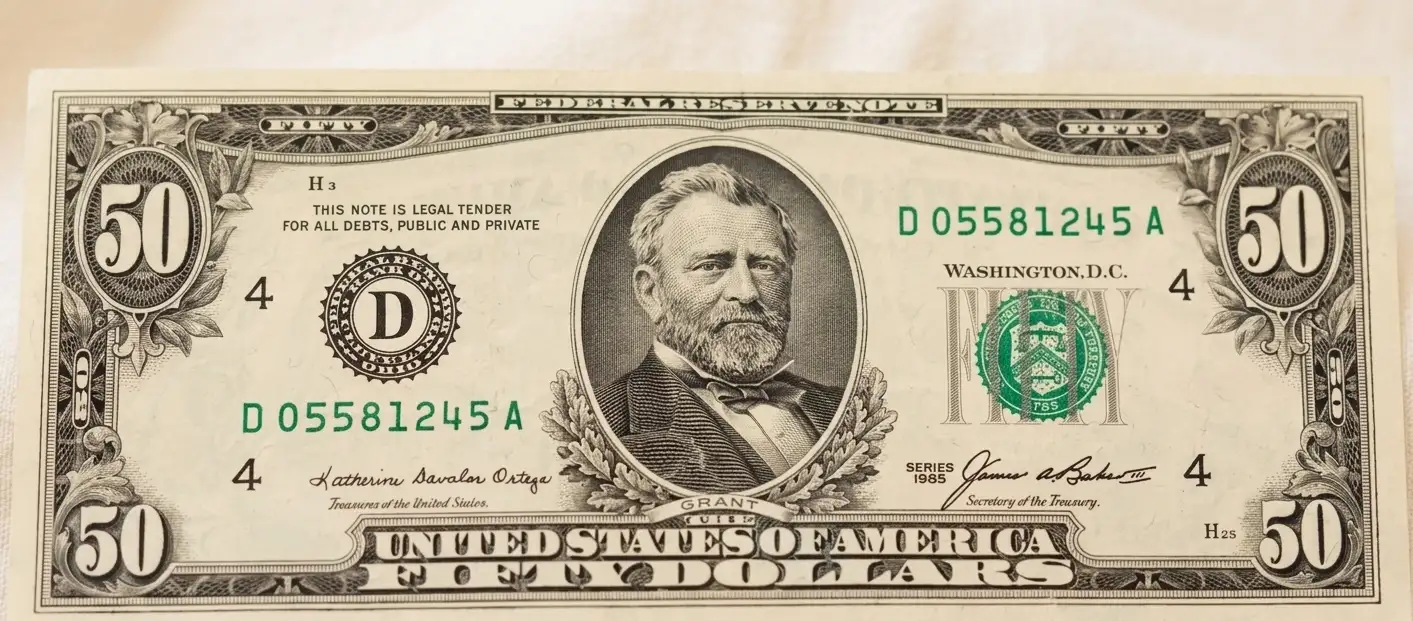
Comparative Analysis with Other Denominations
Beginning hobbyists often ignore the fifty-dollar bill.
Statistics show this creates opportunities for forming rare sets.
$50 Collecting Advantages:
Lower competition compared to the $1 denomination.
Higher note preservation in circulation due to low transaction frequency.
Existence of unique Gold and Silver Certificate series.
Stable price growth for star replacement series.
2024 Mintage Comparison:
$1 — 2.2 billion units → $50 — 163 million units.
Limited supply → Higher resistance to market volatility.
Rare $50 notes maintained their prices during the 2025 economic instability.
Legal Aspects and Payment Status
Every $50 note issued since 1861 remains legal tender.
Invalidating old series is not practiced in the United States.
Old Issue Features:
Pre-1928 Series: Large Size format.
1928–1990 Series: Standard size, lacking modern security.
Federal Reserve Notes: Most common type.
Gold Certificates: Once mandatory for exchange in 1933, now legal.
Market value for large-size notes from the early 1900s starts at $150 for poor condition.
Crisp Uncirculated specimens can exceed $5,000.
US laws prohibit reproducing currency images in full size and color.
Digitalization Impacts on the Note Market
Rising cashless payments in 2024–2026 reduce the need for physical banknotes.
Reducing print orders at the Bureau of Engraving is a direct result.
Collector Consequences:
Lower probability of finding rare numbers in cash registers.
Price growth for existing stocks of uncirculated notes.
Increased value for star notes of the final series.
Accelerated transition to online auctions.
Digital ownership certificates are starting to complement physical collections.
Traditional paper notes are perceived as tangible historical documents.
Cash demand in developing economies supports global dollar circulation.